Proposals to address the lack of affordable housing in Waterloo

I have been drawing attention to the lack of affordable housing in the city of Waterloo, and how the updating of the zoning bylaw now underway could do much to bring more lower-end-of-market rental units onstream.

I have three main proposals:

  1. Reduce the amount of parking required when a condo or apartment building is built. And don’t always require a parking space for accessory apts created in a home. Parking makes construction much more expensive. And in a home, the lack of room for a side-by-side parking spot now means an apartment cannot be allowed – this needs to change.
  2. Remove many other obstacles that now exist to creating apartments in houses and detached garages.
  3. Bring in Inclusionary Zoning in all new developments. This means that every building, subdivision, etc, would have to include a given percentage of affordable units. This leads to a mix of income levels in the same neighbourhood, as opposed to ghettoization.

These three measures could open up the rental housing market substantially.

Here are links to some my recent articles on affordable housing in Waterloo.

Letter to Waterloo Chronicle: City officials have to hear about it on new zoning | Waterloo Chronicle (22 July 2016)

Mention in Waterloo Chronicle (interview with editor Bob Vrbanac): Concerns over new zoning bylaw | Waterloo Chronicle (14 July 2016)

Waterloo Chronicle: Editorial: Take the time to listen (13 July 2016)

Submission to the city’s public input portal on zoning review: Letter to the City of Waterloo on Zoning and Affordable Housing | KWPeace (16 July 2016)

If you think these are good ideas, please write to the papers and your city councillor. There will also be a second round of public input in fall 2016.

Letter to the City of Waterloo on Zoning and Affordable Housing

To Waterloo staff and councillors:

Thank you for the opportunity to give input on the review of our zoning bylaw.

My response pertains mainly to Residential zones. At the end I’ll add some brief ideas on Commercial and Employment zones.

These are the underlying assumptions I am bringing regarding what kind of residential areas would be desirable to live in:

  • Remember that we are building neighbourhoods.
  • Every neighbourhood needs to include green spaces and gathering spaces that facilitate casual encounters with one’s neighbours.
  • Neighbourhood green spaces should be small, frequent, and linked together if possible — user-friendly.
  • Every neighbourhood needs to be walkable and cyclable. No overly long blocks should be allowed, especially if they block access to amenities. Where these mistakes have already happened — on Lester St. and Marshall St. — the city must do its utmost to buy back an easement to insert a walkway. Plus easements to continue these walkways right through to the LRT station beyond Phillip St. and from Lodge St. to the plaza. Extremely important that we find a way to do this.
  • Neighbourhoods would also benefit from having a community centre. Please zone in space for them. Make sure that a conversation is open between staff working on zoning and those developing a neighbourhood strategy.
  • Fewer parking spaces should be required for houses, apartments, and condos.
  • Many apartments and condos could be offered without parking. That is, less than one parking spot per unit.
  • In fact a maximum number of cars should be set, because of the nuisance that cars pose to neighbours. In the vicinity of my house several driveways are being used as parking lots for multiple cars, continually coming and going, so that it’s never peaceful to go to my front yard. I think anything above two cars on a residential lot should have to pay some kind of fee or penalty.
  • What this city lacks most is housing for the whole bottom half of the market, everyone from median income on down. No one is building for them. The young, the pensioners, and the people who serve us coffee, take care of the elderly, clean offices, and provide security at events, should be able to live among us in decency. Providing for this huge demographic should be a prime goal of zoning bylaws. We especially lack lower-end rental units.
  • Every neighbourhood should be planned to include a mix of income levels, and a mix of ownership and rentals.
  • As soon as Inclusionary Zoning becomes available in Ontario — expected in fall 2016 — Waterloo should make use of it for all new development.
  • If density bonusing is used (and I’m not sure it ever should be), the green space and/or affordable housing created should have to be in the same neighbourhood.
  • In traditional neighbourhoods we should make it easier to create secondary units, frequently without parking, to bring lots of affordable housing onstream.
  • And why should we care if a family wishes to use a one-bedroom-plus-den unit as two bedrooms to make it affordable for them? The city should not be in the business of harassing and micromanaging people. Making developers change dens to dining rooms will prevent all residents from having a home office/computer room or guest room. We should do a lot less micromanaging!
  • Finally, every neighbourhood should be visually appealing and where possible reflect the uniqueness of Waterloo and its heritage. New development should fit its context.

I hope these assumptions I’m coming from are also shared by Waterloo officials. How might they apply to the specifics of the zoning bylaw?

Discussion Paper on GENERAL REGULATIONS 2.10 Secondary Dwellings

If a house is spacious enough, why couldn’t it have a basement apartment and/or a coach house unit and/or an upstairs apartment or main floor addition, or even all of these?

Why should it matter that an apartment or coach house be with a detached house and not a semi-detached or townhouse?

Why couldn’t municipal services be connected up to a detached garage in the future (at the owner’s expense); why should the connection have to have existed prior to this bylaw?

Why should it matter what percentage of the floor area of the main dwelling the secondary dwelling is?

Why should every added unit have to have parking?

What DOES matter is that there be adequate green space on the property, that the added units meet standards of safety, space, and decency, and that noise bylaws be enforced. The lot frontage doesn’t matter. Whether the entrance faces the street or the side yard doesn’t matter. We need to pick our battles, so to speak.

I think we should encourage house designs that lend themselves to the future creation of accessory apartments. Give people choice. If a family wishes to create a unit for an elderly parent or a grown child, or both — or if a young homeowner or a widow wishes to add a “mortgage helper” apartment — make it easy to do these things. It should be expected that people will do it. Get rid of the rules that don’t matter. Allow there to be some units designated as no parking.

In this way hundreds of affordable accommodations could be added in the city very quickly, blending into their neighbourhoods and with no ghettoization.

Discussion Paper on LOW-DENSITY RESIDENTIAL

As above, we should anticipate greater density being added by homeowners over the years, and don’t let rules about bedrooms per hectare restrict this too much. It’s the gentlest way to increase density and provide much needed affordable housing.

Discussion Paper on HIGH-DENSITY RESIDENTIAL

I’ve only been able to view a map covering from Erb Street to University Avenue so it’s hard for me to pinpoint locations in the rest of the city.

I think our city needs more RMU-20 throughout the city to provide affordable rentals, now that the province allows frame construction up to six storeys. Not having to provide costly underground parking should allow more affordable units to be built. Don’t require a parking spot for every unit, especially Uptown.

Two good locations for RMU-20 are close to me in the core: Bridgeport Road between Peppler Street and Laurel Creek, and the houses just north of 151 King Street North.

Please change the zoning of 151-161 King Street North so that 151 with its tasteful-density additions is preserved, and the homes between there and the 12-storey building on the corner are designated RMU-20. Best use for that location.

The Bridgeport Road site could have RMU-20 closest to the homes on Peppler, and could step up to RMU-40 nearer the creek. I hope the city will facilitate removing the H provision where the gas station used to be (in front of the carpet warehouse). A good site for development, but not 25 storeys.

These suggestions would both decrease an 81 to a 20. But I’m happy to see an upgrade to RMU-20 proposed for Weber Street, Bridgeport/Royal, and Erb Street East and West. Another spot that should be upgraded to RMU-20 is the apartments at 29 Elgin Street — I’m not sure why it’s shown as R4 on the map. I would also be OK with some R-8 townhouses on King Street between Central Street and 151 King Street North, blending in with 151. That could fit nicely. Alternatively this corner might be a good location for a community centre serving both MacGregor-Albert and Uptown North. Something to think about.

I don’t think there should be any RMU-81 on King between Elgin and Noecker, and perhaps Marshall. (What happened at King/Noecker/James is a ghastly mistake, and I believe the city owes SERIOUS restitution to the St. Sofia church congregation for permitting this encroachment.) I suggest we need a category in between RMU-40 and RMU-81. Say RMU-50, which would allow 14 or 15 storeys. Existing neighbourhoods could more easily live with that.

Less than one parking space per unit should be required, in all of the above. Mandate more and better bicycle parking (this shouldn’t be a “bonus” point but basic). And we need to keep pushing the Region for better transit and be willing to contribute more revenue for it.

So I’m saying: more RMU 20, more allowance for accessory units in R 1-4, less parking, more bike parking, and no 25-storey towers: change RMU-81 to RMU-50.

This option is more affordable for everyone, allows neighbourhoods to feel coherent, and preserves the character of the city.

Discussion Paper on OPEN SPACE …

I like the vision of “urban open space system within built-up areas”. But I didn’t see anything about improving general walkability by avoiding overly long blocks.

Walk/cycle links need to be restored where poor planning in the recent past failed to provide for them: Hickory, Lester, Phillip to LRT and Brighton, Marshall, Lodge to plaza. This must be a high priority, so neighbourhoods can breathe again.

As mentioned above, it is urgent that the city buy an easement for a walkway close to the end of Hickory Street, or else all of Northdale will be locked in forever and frustrating to live in. And make sure the walkway continues all the way to the LRT station and University of Waterloo campus, with some green space along the way.

As for Lodge Street, there’s still time to acquire the land and build a walkway from Lodge Street to the plaza, while working to find a way to get an easement through to Marshall. Please make this a priority.

The ditch running behind University Plaza is a good potential place for green space. Would it be possible to extend it out to Weber and to Regina? This would provide more foot and bike access to the plaza, reducing bicycles on University. A footbridge (or several) over the ditch to the plaza, some trees and stone benches, and a walkway out to Lodge Street and eventually Marshall and Brighton … Please act now to make this happen! Put it on the zoning map. It could be a gem.

A parkette would also be the best use of the low land around the art gallery between Regina and Peppler. And it could eventually be linked across Peppler to Brighton Park. Please pencil it in and work toward assembling it over the years.

These are two or three examples of walking links and green space potential in my immediate neighbourhood. And are there any plans to complete Laurel Trail from Weber Street to Moses Springer Park? Just five or six houses …

Much more could be done with Laurel Creek uptown as well, as regards green space.

Parkettes need to be an integral part of all future development. As mentioned above, it should not be allowed to “horse-trade” parkland fees for green space far away; the green space should have to be where the development is. Same goes for affordable housing; it should have to be on the site.

Affordable housing, walkability, and green space. Zoning can do so much to enhance them all. In these ways we can build future neighbourhoods that feel safe and fostering for all the diverse ages, incomes, cultures, household types, and occupations of people who will live here.


Here are two articles on visioning urban growth that I found inspirational:

Density at a Human Scale, by Kaid Benfield:
http://www.sustainablecitiescollective.com/kaidbenfield/988196/smart-growth-not-all-urban-density-created-equal

Zoning for Happiness in Edmonton:
http://edmontonjournal.com/news/insight/in-a-happy-zone-how-planning-rules-can-improve-a-neighbourhood-vibe

And new info: Ontario’s Climate Action Plan will legislate away cities’
ability to require parking minimums:
http://tvo.org/article/current-affairs/the-next-ontario/why-parking-spots-in-the-gta-could-get-scarcer-and-pricier


Let me conclude with a few thoughts on Commercial and Employment zones:

Less parking! Less parking! Less parking! I support the points regarding parking made by TriTAG at:
http://www.tritag.ca/blog/2016/03/20/can-the-city-of-waterloo-move-beyond-parking-minimums/

Employment districts in north Waterloo need much better bike and bus access. They need to be much better integrated with the city and include mixed uses.

I also think we need a rule that nothing can be built that’s only one storey. Industrial “parks” are huge space wasters. If production needs to be on one level, some other use could be built above.

There also need to be strong incentives to include on-site renewable energy and green roofs.


Thank you for your time in considering all these suggestions regarding how Waterloo should grow. Our residential areas, and commercial and employment areas too, should promote neighbourliness and inclusion, and commitment to place, and good stewardship.

Eleanor Grant

@Eleanor70001 writes a Letter to the Editor on Zoning Review

The letter was published in the Waterloo Chronicle on 22 June 2016: City officials have to hear about it on new zoning

Hi All,

I sent the letter below to the Waterloo Chronicle and they replied accepting it, but unfortunately they didn’t get it in this week. That means they haven’t yet given it a URL link I could have sent out on Twitter.

I am trying to launch a conversation about how we can tweak the zoning bylaws to create more affordable housing. Zoning Review is going on right now in all 3 cities in WReg, but the window for public input will soon close.

Please add your ideas and circulate this. And be sure to send comments to your city.

Much appreciated,

Eleanor

From: “Eleanor Grant” <eleanor7000@gmail.com>
Date: 13 Jun 2016 13:26
Subject: Letter to Ed on Zoning Review
To: “editorial” <editorial@waterloochronicle.ca>

To the Editor, Waterloo Chronicle:

We had a lively meeting at the Rec Centre on June 9, organized by Uptown ward councillor Melissa Durrell, to discuss the new draft zoning bylaw. Everyone should see this new map. (See Waterloo.ca/ZoningReview)

Now’s our chance to let city officials know if we like or don’t like their proposed changes, and suggest our own (within some limits). Comments are open till July 4.

The neighbourhood associations present at the meeting expressed a desire for medium-rise zones to buffer traditional neighbourhoods from new high-rise development. They also wanted to see more local parkettes.

It was a revelation, for example, that high-rise developers were able to increase density in exchange for paying a parkland fee – but the parkland money went to beautify Waterloo Park, not to create green space in the neighbourhood where the fee was collected. But children and seniors need places to play, and meet their neighbours, close to home day to day.

Another topic that came up is affordable housing. The zoning bylaw presents many needless obstacles, for example by making it hard to create “secondary” units and Granny flats in residential neighbourhoods. Why don’t we facilitate this? The “free market” is failing to provide one-bedroom rental units that seniors and low-wage workers can afford.

Get rid of those stringent parking requirements. Allow some rental units to be designated as no parking. The people who need low-rent units usually don’t have a car.

Thanks to the work of outgoing Minister of Municipal Affairs Ted McMeekin, Ontario now allows cities to use Inclusionary Zoning. This means that new multi-unit buildings would have to include a designated percentage of affordable units. If all developers have to do it, then none can complain that they’re at a competitive disadvantage.

Waterloo should act now to adopt Inclusionary Zoning in the Uptown area, so that there will be some affordable housing that’s near transit.

There’s a lot we can do to build a more inclusive and friendly city, just by tweaking the zoning bylaws.

But it won’t happen until the officials hear from us!

Eleanor Grant

An invitation to protest the TPP in Toronto on Friday, 13 May 2016

Jodi Koberinski @JodiKoberinski of Dangerous Ideas writes:

To get into the hearings, arrive at Ritz Carleton by 8:00am… Protests and a people’s hearings (running as a parallel process) outside the Ritz Carleton beginning at 9am…

also check out Shiv Chopra and the Canadian Council for Food Sovereignty and Health’s tour and youtube videos….


Civil society protests outside the House of Commons trade committee hearings on the TPP in Vancouver, Winnipeg and Saskatoon.

The House of Commons standing committee on international trade will be in Montreal, Quebec City, Windsor and Toronto this week to hear testimony on the Trans-Pacific Partnership (TPP).

And civil society will be there to let them know that they want the TPP stopped and that the hearings themselves are not as inclusive or welcoming to the public as they should be. At the previous committee hearings in Vancouver (April 18), Calgary (April 19), Saskatoon (April 20), and Winnipeg (April 21), members of the public had to produce identification, have their bags searched, and be frisked. Only 12 organizations were allowed to present at the 1-day hearing in Vancouver, even though 175 people had registered to testify.

The hearings will take place this week in Montreal (May 10), Quebec City (May 11), Windsor (May 12) and Toronto (May 13).

In Montreal, the Council of Canadians, Citizens in Action, and the Raging Grannies will be outside the Queen Elizabeth Hotel (900 René-Lévesque West) this Tuesday at 8:30 am with placards, banners and images of what they hold dear that would be threatened by the TPP.

In Windsor, the Council of Canadians Windsor-Essex chapter will be outside the Best Western PLUS Waterfront Hotel (277 Riverside Drive West) this Thursday at 8:45 am. They will be setting up a speakers corner for anyone wishing to send a video message to the House of Commons committee.

And in Toronto, the Council of Canadians, OpenMedia, LeadNow, the Trade Justice Network, Common Frontiers, and others are organizing an action outside the Ritz-Carlton Toronto (181 Wellington Street West) on 9:00 a.m. this Friday.

Unifor has also just announced this morning that it will hold rallies in both Windsor and Toronto at 10 am outside the hearings, as well as help fill the hearing rooms in these two cities.

Presumably in response to criticisms that the committee has only heard from a small number of organizations and not concerned individuals in the cities it has visited already, the committee has now scheduled one-hour at the end of each of day for “Spontaneous Presentations”. NDP MP Tracey Ramsey, a member of the committee, says, “Members of the public who wish to speak at these sessions must register on-site. The list of speakers will be determined on a first-come, first-served basis. The Committee Chair will decide how much time each speaker will be given based on the number of speakers.”

The hearings have already been met with protests.

In Vancouver, the Council of Canadians Vancouver-Burnaby chapter joined with OpenMedia, LeadNow and other allies to unfurl a large banner outside the hotel where the hearing was taking place. The banner said, “170,000 Say No To TPP”. The groups also organized to have a 16 foot high Jumbotron outside the hotel with messages of concern from people across the country.

In Saskatoon, the Star-Phoenix newspaper reported, “Members of Climate Justice Saskatoon and the local chapter of the Council of Canadians set up placards and protested outside the Radisson Hotel during a public consultation on the Trans-Pacific Partnership (TPP) trade agreement.”

And in Winnipeg, Council of Canadians organizer Brigette DePape tells us, “Activists from Migrante Manitoba, No One Is Illegal, the University of Winnipeg Student Association, Solidarity Winnipeg, the Public Services Alliance of Canada, and the Council of Canadians chanted and distributed leaflets outside the Delta Winnipeg Hotel where the hearing was taking place.”

Beyond attending the hearings, you can also email your comments on the TPP to the committee via email at ciit-tpp-ptp@parl.gc.ca The committee is accepting written submissions (of no more than 1,500 words in length) until June 30. Media reports suggest that the House of Commons will vote on the ratification of the TPP in the fall of 2017, just before the November 2017 deadline set by the 12-signatory countries.

For our critique of the TPP, please see our campaign web-page.

This item was mirrored from An invitation to protest the TPP this week! | The Council of Canadians

Welcome to the new home for KWPeace

KWPeace logo
KWPeace
Thanks to the sponsorship of Educators for Justice and the generosity of web hosting provider CCj/Clearline the KW Peace blog has moved to a new site at http://kwpeace.ca/.

An initiative of the Kitchener Waterloo Peace and Social Justice Community Symposium, the new site gives more flexibility to add things like a comprehensive calendar of all Peace and Social Justice events in the Kitchener–Waterloo area, and mailing lists for the KW Peace groups to coordinate those events.

Thank you for joining us on our new site!

–Bob Jonkman,
KWPeace Blog System Administrator.

Eleanor Grant’s speech on Hydro One to Kitchener city council

This is the 5-minute presentation I made to Kitchener city council on the subject of the privatization of Hydro One, on 2015 June 29.

Mayor Vrbanovic, Councillors & Staff, fellow citizens:

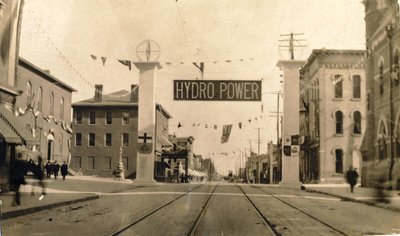
Hydro power celebration, Berlin, Ontario
We’ve all seen the inspiring pictures of the night when Berlin, Ontario was electrified in 1910. The banners over King St proclaimed POWER FOR THE PEOPLE.

Adam Beck — a staunch Conservative by the way — fought for hydroelectric power to be a public asset — Why? Because he wanted businesses across Ontario to have equal access to affordable power. Later he worked hard to get homes and farms electrified as well. Since the days of Sir Adam Beck, we’ve all come to see Ontario Hydro and its successors as a sacred trust and a source of pride.

If we were to lose public ownership and control over Hydro One, the potential impact on Ontario’s cities and our local distribution companies could be enormous.

You may have seen our MPP Daiene Vernile’s column in the Kitchener Citizen, which outlines the government’s position for privatization. She states that by retaining a 40% share, Ontario could somehow prevent the outcomes we all fear: skyrocketing rates, shares becoming resold and consolidated in foreign hands, and loss of all regulatory influence. Ms Vernile’s arguments don’t add up, to my mind anyway.

Let’s look at the possible impacts on Kitchener-Wilmot Hydro. What if KWH had to start paying a lot more for transmitted power? If our Hydro bills soared, would we have any recourse? Suppose that this Council, or a future one, wished to bring in a local power generation policy, could we be sued under the WTO? How great would the pressure be to let private interests buy up KWH? How would the new “Hydro Ombudsman” that Ms Vernile speaks of, be able to protect us against such forces?

If we don’t know the answers to these questions and more, then we need time to do the necessary due diligence. We need to ask the Province not to go ahead with this privatization plan at this time.

I have received endorsements from the leadership of several local groups: the Waterloo Regional Labour Council, Grand River Environmental Network, and the Council of Canadians, who will be bringing the issue of Hydro One before Guelph Council soon. I’ve also received support from former Councillor Jean Haalboom, and from Councillor Zyg Janecki who happens to be in Sask tonight.

I urge you to look into the questions I raised above with some urgency. The first IPO of 15% of Hydro One is already being prepared. There’s no time to lose.

Please let the Ontario government know that the people of Kitchener still want “Power for the People” to be a continuing reality, and not a distant memory.

Since the clerk’s office had twice refused to register me as a delegation, I had 5 minutes to speak and no standing on the agenda.

After my presentation, Councillor Yvonne Fernandes tabled a motion, seconded by Councillor Frank Etherington, similar to the motion on Hydro One adopted by the city of Oshawa. But Council voted not to debate or vote on her motion.

I hope this isn’t the end of the story …

Readers, no matter what municipality you live in, please tell your Mayor and Councillors that you’d like them to pass a resolution asking the Ont gov to Keep Hydro Public! More than 40 municipalities already have.

Eleanor Grant
Waterloo

Links:

Hydro power celebration, Berlin, Ontario from the Kitchener Public Library Grace Schmidt Room of Local History.
Copyright Statement: Public domain: Copyright has expired according to Canadian law. No restrictions on use.

@FairvoteWRC hosts CETA Panel Discussion — Thursday, 1 May 2014 at 7pm

CETA Poster
CETA Poster
Just a reminder of Fair Vote Canada Waterloo Region Chapter‘s panel discussion on CETA, the Comprehensive Economic and Trade Agreement. On the panel are Stephen Woodworth, Member of Parliament for Kitchener Centre, and Angelo DiCaro, trade researcher for Unifor. The discussion will be moderated by Cathy MacLellan.


What: CETA Panel Discussion
When: Thursday, 1 May 2014 from 7:00pm to 8:30pm [iCal]
Where: Lyle S. Hallman Faculty of Social Work, 120 Duke St., Kitchener, Ontario [map]
Who: Hosted by Fair Vote Canada Waterloo Region Chapter (@FairvoteWRC)
Research: Canada-EU Trade Agreement | Canada’s Economic Action Plan

Easy Actions on Health Care, Fair Elections, Fair Taxes, and new Costco in Waterloo

Eleanor Grant writes:

A lot going on these days!

Please sign these action alerts and tell others.

Peace,

Eleanor Grant

HEALTH CARE

VOTE Sat April 5 to Save our Local Hospitals!

Please go to Ontario Health Coalition for location of “polls” in KW where you can express your preference for maintaining our public hospitals.

If you miss the poll you can vote on-line.

Background:
Ontario’s Wynne Government Plans to Bring In Private Clinics: Threatens
Non-Profit Community Hospital Care

The Ontario government plans to introduce private specialty clinics to take the place of local community hospitals’ services. The government’s proposal would bring in legal regulations under the Independent Health Facilities Act and the Local Health System Integration Act to usher in private clinics and shut down services in community hospitals. Ontario’s Auditor General reported in 2012 that more than 97% of the private clinics under the Independent Health Facilities Act are private for-profit corporations. The Ontario Health Coalition warned about the costs and consequences of private clinics for patient care in a press conference at Queen’s Park today. In addition to the danger of for-profit privatization, coalition director Natalie Mehra raised concerns about poorer access to care and destabilization of local community hospitals.

The coalition challenged the government to:

  • Amend the IHF Act to specify that no future Independent Health Facilities
    can be for-profit.
  • Amend the LHINs Act to specify that LHINs cannot transfer services to
    for-profit corporations.
  • Ensure that all clinics or satellites are brought in under the Public
    Hospitals Act and therefore covered by its legislative and regulatory
    protections for quality of care, non-profit governance, and the public
    interest.

ALSO, as the Canada Health Accord for federal transfers to the provinces for health care expires TAKE THE MEDICARE PLEDGE.

STOP THE UNFAIR ELECTIONS ACT !

Leadnow.ca: Stop US-style voter suppression from becoming Canadian law

and

Council of Canadians: PETITION: Investigate and prevent electoral fraud with a truly fair Elections Act

Background Articles from the Cambridge Times

DONE YOUR TAXES YET?

How much revenue does Canada lose every year to tax havens? Please visit Canadians for Tax Fairness to send a message to your MP to look into this.

AND IF YOU LIVE IN WATERLOO

At 6:30 Monday night, April 7, Waterloo city council will consider a zoning change that would allow a COSTCO store to be built on Erb St W, right across from the dump.

Here’s a backgrounder from Kevin Thomason of Grand River Environmental Network (GREN).

Please send a message to your city and regional councillors – links at end of Kevin’s message. I will be one of many delegations at the council meeting Monday. Come out if you can!

Hello GREN folks,

This coming Monday, April 7th, Waterloo City Council will vote to approve a proposal to build a Costco Membership Warehouse on Erb St. across from the Waterloo Landfill. The facility is expected to total over 200,000 square feet with a 975 car parking lot, a 16 pump gas bar, and additional big-box stores. It is estimated the development will attract more than 5,500 cars per day with weekend peak hours surpassing 1,400 cars per hour. The projected opening date is December, 2014.

While many people in Waterloo are excited about a Costco coming to town, few are aware of the significant issues we face. There are a numerous unanswered questions and issues that need to be addressed before a final decision is made:

  1. Widespread Traffic Congestion – Almost all other Costco’s are located near multiple arterial roads and freeways designed to handle high traffic volumes. This Erb St. location is a two-lane road already facing traffic issues. As a result planners are predicting:
    • Severe delays and widespread congestion on area roads with overflow traffic impacting residential streets and even rural roads in Wilmot Township
    • Travel times to increase dramatically, as speeds on some roads during peak times drop to below that of walking speeds. For example, parts of Erb Street with current travel times of less than 1 minute, are expected to increase to 7 to 9 minutes to travel less than 750 meters. This is even after a widening to four lanes in 2018.
  2. Infrastructure Issues – Commercial development is part of the City Official Plan but development was not expected until 2018 after area roads such as Erb Street, Ira Needles and Columbia Street are widened. And such large scale development surpassing 200,000 sq ft was never anticipated. Other necessary infrastructure such as sidewalks, trails, bus routes, etc. isn’t expected to reach the development until several years after opening.
  3. Communications and Public Engagement – Neither the City of Waterloo, The Rice Commercial Group (the developer), or Costco are planning any public information sessions, open houses or consultation events about this proposed development prior to the final vote this coming Monday, April 7th. Staff reports and most studies were just released to the public days ago and most citizens have learned about this plan in recent newspaper articles from the Waterloo Chronicle:
  4. Other Area Impacts – Both Costco and the Regional Landfill share the same peak hours. The landfill is already experiencing queuing issues, causing cars to back up out onto Erb Street right where new roundabouts are to be located for Costco. This would bring traffic to a standstill as cars would be unable to get through the congested roundabouts.
    • Severe congestion could restrict the ability for Fire, Police and Ambulance services to reach the Costco area, the communities beyond, or even return to the city from the EMS training center in case of an emergency.
    • Environmental and ground water recharge areas to the north could be overwhelmed by traffic seeking to avoid the predicted severe traffic congestion on Erb St, Ira Needles Blvd, Columbia Street, etc. This could reverse years of efforts to protect these vital parts of our community.

Few can fathom that a high volume store such as Costco could be built with only one two lane road for access on the onset and ultimately only two roads reaching the store by 2018. The resulting long-term congestion could so negatively impact so many Westside area roads and neighbourhoods. However, this is the plan being recommended by City Staff (report link below) for final approval this Monday night.

What You Can Do

It is really important that we raise the awareness about the importance of Monday’s City Council vote as our community could be impacted by a hasty decision here for decades. Here are some easy things that you, your family, friends, and neighbours can do:

  • Contact City and Regional Councillors: Tell them that an approval would be premature and ask them to support a motion to defer decision until after public consultations and integrated traffic plans have been completed. You can reach all City Councillors at one simple e-mail address – council@waterloo.ca and Regional Councillors at regionalcouncillors@regionofwaterloo.ca
  • Get your social networks involved: Start conversations and ask questions on Twitter and Facebook about the issues that concern you the most. Use the hashtag #WCostco so the community can easily follow the conversation;
  • Write a letter to the editor and get local media engaged in the vital community discussions surrounding this proposal and what sort of community we seek to become;
  • Attend Monday’s City of Waterloo Council meeting for the vote on the Costco development proposal. Register to speak if you like or simply be present to support other presenters. A strong attendance and showing of concern from the community will be important as an empty room sure wouldn’t send a strong message to Council;
  • Learn more by reading the City and Developer Reports.

Hopefully we can collaborate as a community with the City, the Region, the developers, and Costco to find the best path forward for our community and not rush into a situation with so many unanswered traffic, EMS, environmental, and financial questions with no way out after the zoning approval being sought on Monday.

Please let us know any questions, thoughts, or ideas.

Kevin.


Kevin Thomason

1115 Cedar Grove Road
Waterloo, Ontario Canada N2J 3Z4

Twitter: @kthomason
E-mail: kevinthomason@mac.com

Eleanor Grant writes a semi-regular e-mail newsletter on social justice issues. You can contact Eleanor at eleanor7000@gmail.com

Is Fair Elections Act Fair? — Panel Discussion Wednesday, 23 April 2014, 7:00 pm

From the Social Planning Council of Kitchener-Waterloo web site.

Despite widespread opposition, the process moves onwards with the Bill C-23 called the “Fair Elections Act”. End of March, it passed second reading in the House of Commons by a vote of 149 to 131 – with all opposition parties and independent MPs voting against it. If passed into the Fair Elections Act, it would: eliminate vouching, disallowing voter ID cards as valid identification of residence, change regulations surrounding campaign financing, limit the ability of Canada’s chief electoral officer to speak publicly, and more.

April 23rd at 7 p.m. at W-K United Mennonite Church in Waterloo, we are hosting “Is Fair Elections Act Fair?” Awareness Panel to talk about the impact of the proposed changes for low-income people, seniors and youth, Aboriginal population, people with disabilities, homeless.

W-K United Mennonite Church
15 George Street, Waterloo ON N2J 1K6 [map]

7 – 8 pm Welcome & Panel presentations [iCal]

Peggy Nash, MP Parkdale-High Park
Prof. Mathieu Doucet, University of Waterloo
Sharon Sommerville, Fair Vote Canada WR chapter

8 – 9 pm Questions to the panel and discussion

For more information and to RSVP, contact maria@waterlooregion.org.

Organized by the Social Planning Council KW, Poverty Free KW, FairVote WR, WR Labour Council, TransitionKW, Homelessness Awareness Week, Canadian Federation of University Women KW.

"Is Fair Elections Act Fair?" poster
Is Fair Elections Act Fair?

“Is Fair Elections Act Fair?” poster advertising the Social Planning Council of Kitchener-Waterloo panel discussion on 23 April 2014.

Original .PDF file: Panel_April23_2014.pdf, 555.28 kBytes.